The Invisible Hero
A Choreography of Precision and Trust


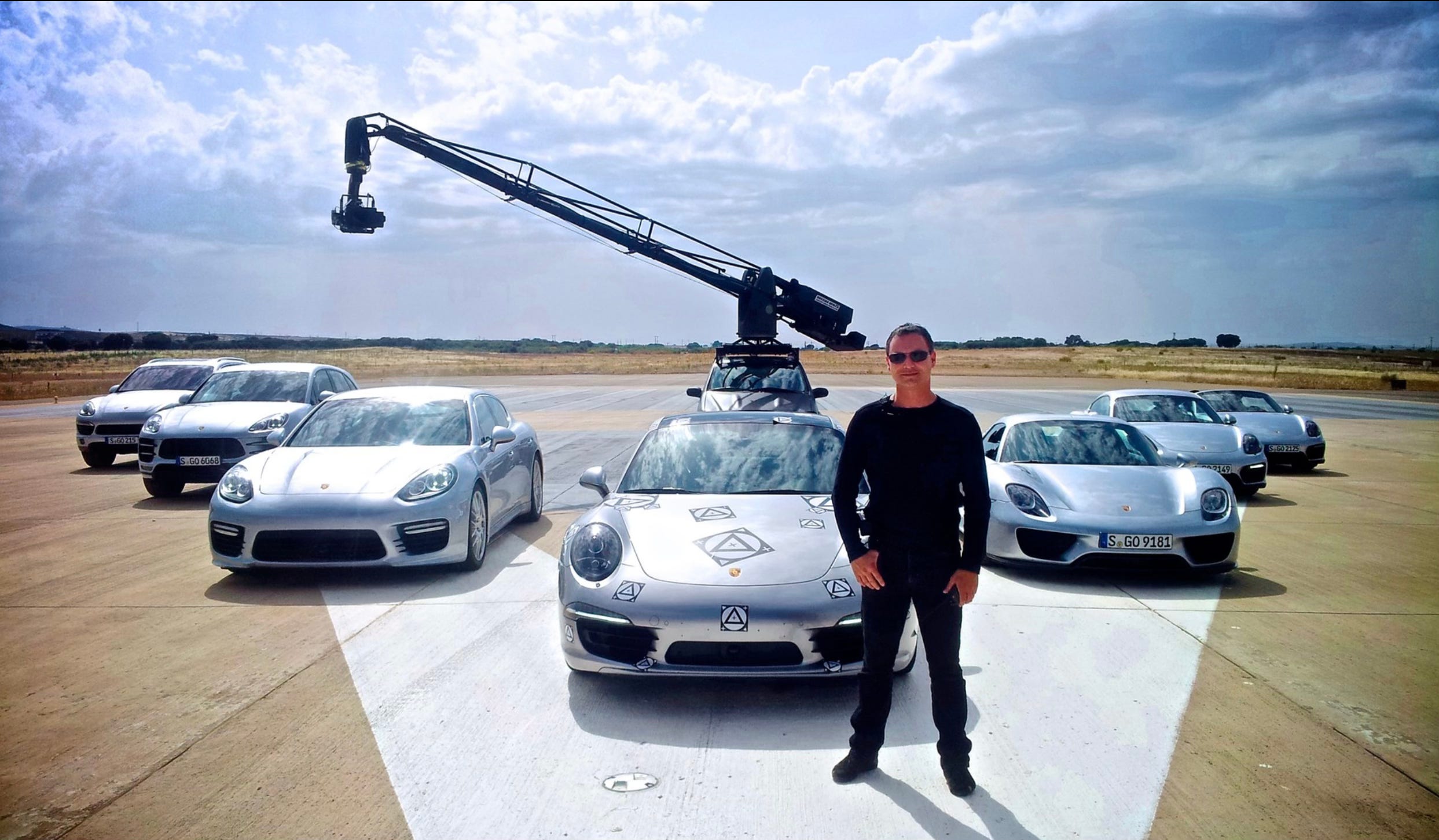
It is time for another entry here on Substack. This time, I’d like to take you back to 2018, to a story centered around the photograph above. The setting: a decommissioned airfield in Spain.
I had been called in as a Stunt Coordinator, leading my team for a high-stakes project that required far more than just making a car look good on camera. We weren’t just filming a single vehicle; we were orchestrating an entire product range for a Porsche commercial. The goal was to make these machines “dance” together.
The Ghost in the Machine
There was a peculiar challenge to this assignment: the actual “Hero Car” was so top-secret that it wasn’t even allowed on set yet. To solve this, we used a current 911 Carrera fitted with tracking marks. This allowed the post-production team to digitally replace the car with the future prototype via CGI.
When I arrived on set, I went straight into the first briefing with the client, the director, the cinematographer, and the agency’s creative leads. The air was thick with tension. The expectations were immense: they demanded maximum performance, zero accidents, no damage to the vehicles, and a relentless pace. As the saying goes, “Time is money.”
In that circle of anxious faces, I was perhaps the only one who felt truly calm. I knew my own capabilities, but more importantly, I knew the caliber of the men standing behind me. Every precision driver on my team had at least a decade of experience. These were professionals who had handled supercars in Hollywood blockbusters or held world titles in drifting. I knew I could rely on them implicitly.
The Ritual of the 4:30 AM Call
The next morning began as it always does: a 4:30 AM pickup by black vans at the hotel. A heavy silence filled the air. Everyone climbed into their respective minibuses, settling in to enjoy the last moments of “the calm before the storm” on the way to the airfield.
There is a certain rhythm to film sets—an unwritten script that every production seems to follow. We hadn’t even come to a full stop when the door was yanked open. The unit manager, looking frantic and gesturing wildly, shouted, “We have to get to the location immediately... the sun is coming up, and we need this light for the packshot!”
After all these years, I still find it mildly amusing how “surprising” the sunrise is in mid-summer. One wonders why we aren’t simply picked up thirty minutes earlier. But my only real concern in that moment was the realization that, once again, there would be no time for coffee or breakfast. And if there is one thing I dislike, it is starting a high-precision workday without a fresh cup of coffee.
The High-Speed Ballet
We moved to the runway. After a brief final coordination with the director and the U-Crane (camera car) driver, I headed to my vehicle.
What followed was a feat of multitasking. With my left hand, I performed a radio check with my team in the other Porsches. With my right, I communicated with the U-Crane crew. Seats, steering wheels, and mirrors were adjusted to the millimeter. Then, we began.
From that point on, I operated on a sort of professional autopilot. We thundered down the runway at 180 km/h in a V-formation, then shifted into a broad line, door-to-door. On the camera monitor, the cars appeared to be touching, though in reality, we maintained a gap of only a few centimeters. The U-Crane darted from left to right just inches from our bumpers, the camera boom swinging mere hand-widths above our hoods.
I didn’t have the luxury of focusing solely on my own driving. I was busy directing 12 people across 8 different vehiclesvia two radios.
“Panamera, twenty centimeters to the left...” * “918 Spyder, a hand-width forward...” * “U-Crane, prepare for a counter-move, left to right...”
One choreography followed another. Between takes, I was motivating the team, consulting with the director on the technical nuances of the shot, and ensuring the cars were cleaned and refueled. Adrenaline, not blood, felt like it was pumping through my veins.
The Weight of Trust
And then, just as the “dance” began to feel like second nature, the voice crackled over the radio: “Ladies and Gentlemen... that’s a wrap!”
We had done it. As is almost always the case, we finished without a single error or a scratch on the paint. Even after years in this industry, the relief is profound. The tension that has been pressing down on you for 15 hours suddenly evaporates the moment you turn off the engine and hand over the keys and the radio.
The most important part of the day, however, comes at the very end. I gathered my team to thank them. High fives, embraces, a few words on a job well done.
On the drive back to the hotel, I often reflect on the nature of this work. I am flown around the world to orchestrate the most daring maneuvers imaginable with some of the finest machinery ever built. But the “best” part of my job isn’t the cars or the locations.
It is the trust.
I have a team so professional that they execute the wildest instructions without a second of hesitation. And they do so because they know I would never ask for something that puts their lives at unnecessary risk. They trust me blindly, and I trust them with the success of the entire production.
If only we could translate that level of mutual trust to the rest of the world... I would give everything for that.
What role does trust play in your professional environment? Is it something earned over decades, or a necessity from day one?
Uwe Mansshardt
Stuntcoordinator and CEO of Varuna Mitra
 | A guest post by
|